
Big picture: Studying in Canada
Canada is one of the top destinations for international students, with strong universities, relatively clear admission processes, and options to work after graduation through the Post-Graduation Work Permit (PGWP).
University rankings in Canada
Different ranking systems use different criteria (research, reputation, teaching, international outlook), so “top” can vary slightly depending on the list.
Across major rankings (QS, Times Higher Education, U.S. News, Scimago), the same group of universities almost always appears near the top: University of Toronto, University of British Columbia, McGill, Alberta, Montréal, McMaster, Waterloo, Ottawa, Calgary, Western.
Here’s a simple snapshot using recent global rankings (QS and Scimago as examples):
| University | Typical global position range | Notes for you as an applicant |
|---|---|---|
| University of Toronto | Top 20–30 worldwide | Very competitive, huge range of programs. |
| University of British Columbia | Around top 40–60 | Strong in sciences, engineering, environment. |
| McGill University | Around top 30–50 | Very international, strong for health, sciences, arts. |
| Université de Montréal | Top 150–200 | French-language, good for STEM and health. |
| University of Alberta | Top 100–150 | Strong in engineering, energy, sciences. |
| McMaster University | Top 100–150 | Known for health sciences and engineering. |
| University of Waterloo | Top 150–200 | Famous for CS, engineering, co-op internships. |
| University of Ottawa / Calgary | Top 150–250 | Good options, slightly less competitive than Toronto/UBC/McGill. |
Rankings are helpful, but for your own application you should also look at:
- Specific program strength (e.g., CS vs. business vs. engineering)
- Location and cost of living (Toronto/Vancouver vs. smaller cities)
- Co-op or internship options (Waterloo, some programs at Alberta, Calgary, etc.)
General international admission process
Every university has its own details, but the overall flow for an international student is quite similar:
-
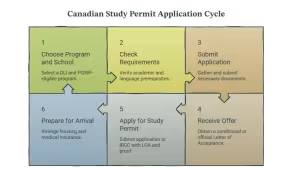
Choose program and school (Designated Learning Institution – DLI)
- You check if the school is a DLI (needed for a study permit) and whether the program is PGWP-eligible if you want to work in Canada after graduation.
-
Check academic and language requirements
Typical requirements at many institutions include:
- High school diploma (for undergraduate) or bachelor’s degree (for master’s) with minimum grades.
- Proof of English proficiency: usually IELTS or TOEFL (exact scores depend on the school and program; some schools list minimum around IELTS 6.5+ for degree programs, while some vocational programs accept 5.5+).
- Sometimes specific prerequisite courses for certain programs (e.g., math/physics for engineering, biology/chemistry for health programs).
-
Submit application to the university/college
Common documents:
- Online application form + application fee
- Passport copy
- Transcripts and graduation certificates
- English test scores (IELTS/TOEFL/PTE/others accepted by that school)
- For competitive programs: statement of purpose, recommendation letters, CV.
-
Receive an offer of admission / Letter of Acceptance
Some schools first issue a “conditional offer” or “offer letter”, then after you accept and pay a deposit/registration fee they issue the official Letter of Acceptance (LOA). This LOA is required for your Canadian study permit application.
-
Apply for Study Permit (student visa)
- You use the LOA plus financial proof, passport, photos, and other documents on IRCC (Immigration, Refugees and Citizenship Canada) to apply for a study permit.
- For programs longer than six months, a study permit is mandatory.
-
Prepare for arrival
Schools may ask you to:
- Show proof of medical insurance
- Arrange housing and maybe attend orientation once you arrive.
Canadian Application Admission Cycle
Things to pay attention to
As an international student, you need to pay special attention to:
-
English proficiency
- Check each university’s required IELTS/TOEFL scores for your program. Undergrad and grad programs often require higher scores than short diplomas.
-
Program length and PGWP
- If you want work opportunities in Canada after graduation, confirm that your program is PGWP-eligible and long enough (often 2 years gives a 3-year PGWP, but always check the latest rules).
-
Deadlines and intake terms
- Many Canadian universities have main intake in September (Fall) and sometimes January (Winter) or May (Spring/Summer). Applications typically open many months before, so planning 1 year in advance is safer.
-
Designated Learning Institution (DLI) status
- Only DLIs let you get a study permit. Make sure any college or university you consider appears on the DLI list.